Every time Vicki and I travel to Europe, I come home with more questions than I left with. I enjoy the scenery, the food, and the architecture, but what really interests me is how people live, how their history has shaped them, and how differently their societies have developed from our own.
Our August trip to Croatia and Slovenia was particularly interesting in that regard. These were countries I grew up knowing collectively as Yugoslavia. Having served in the Army during the Cold War, I remember a very different map of Europe than the one we have today.
Now, here we were traveling through countries that didn’t even exist as independent nations when I was in the military.
Getting There
Vicki and I departed Washington Dulles on August 21, flying through Frankfurt before arriving in Zagreb, Croatia. Our trip would take us through Slovenia and back into Croatia, eventually working our way down the Adriatic coast to Dubrovnik.
It was an interesting itinerary because it encompassed everything from the Alpine landscapes of Slovenia to the Mediterranean coastline of southern Croatia.
Zagreb, Croatia
I’ll admit that Zagreb didn’t make the greatest first impression on me. Parts of the city were rather unattractive, and there was still considerable evidence of the damage caused by the earthquakes of 2020. I was surprised that so much restoration work remained unfinished six years later.
Zagreb does, however, have an interesting history. Being there got me thinking about Yugoslavia and its place in the Cold War.
Although Yugoslavia was a communist country under Josip Broz Tito, it wasn’t a Soviet satellite state in the same sense as Poland or East Germany. Tito broke with Stalin in 1948 and pursued a relatively independent path between the East and West.
I also found myself revisiting the history of the breakup of Yugoslavia, the wars of the 1990s, and American involvement during the Clinton administration. It’s interesting how your perspective on historical events changes over the course of your life, particularly when you find yourself standing in the countries where those events took place.
And, of course, who of my generation could forget the Yugo? That inexpensive little car that became something of a running joke in America was manufactured in what is now Serbia.
Slovenia: A Pleasant Surprise
Slovenia was a completely different experience.
Almost immediately, I was struck by how picturesque the countryside was. There were mountains in the distance and these little communities of houses clustered around churches. It looked like something you’d see on a postcard.
There was also a noticeable sense of prosperity. It made me curious about Slovenia’s transition from Yugoslavia’s socialist economic system to a market economy and why its economic development differed from that of some of the other former Yugoslav republics.
Geographically, Slovenia sits at an interesting crossroads between Central Europe, the Mediterranean, and the Balkans. You can see those influences in the architecture and certainly in the food. The Italian influence was particularly noticeable, with pizza and gelato readily available.
I also noticed similarities between the sound of the Slovenian language and Polish. Both are Slavic languages, although they belong to different branches of that language family. It’s one of those things I probably never would have thought much about had I not been there listening to people speak.
Ljubljana
Ljubljana, the capital of Slovenia, has a much different character from Zagreb. Its historic center, bridges, riverside architecture, and pedestrian-friendly layout give it a distinctly Central European feel.
One of the things I appreciate about European cities is how much of their public life takes place outdoors. Their historic city centers are often places where people actually live, eat, shop, and socialize, rather than simply historic districts preserved for tourists.
Ljubljana is a good example of that style of urban living.
Lake Bled
We spent two nights in Bled, an Alpine resort town that is probably one of the most recognizable destinations in Slovenia.
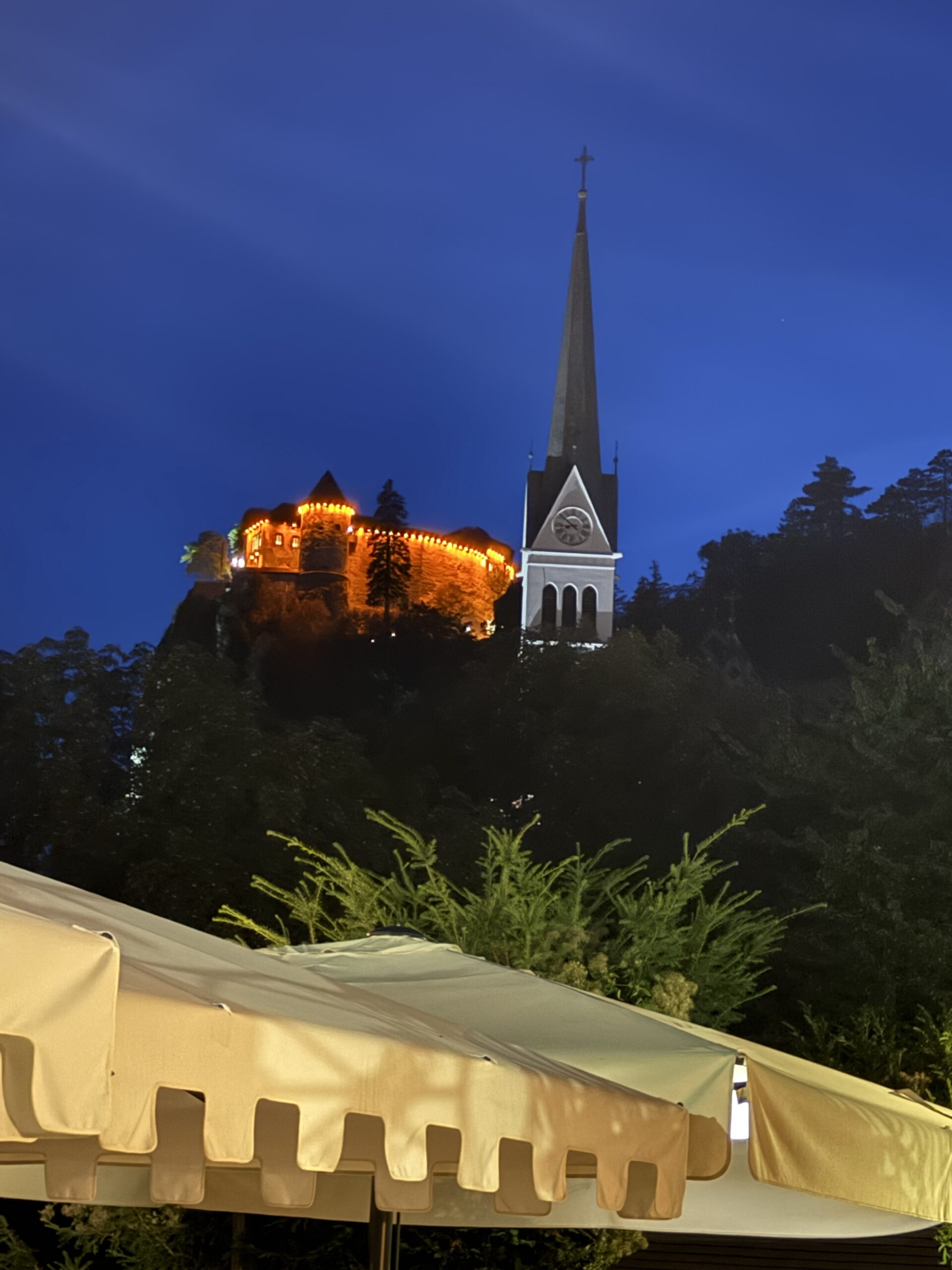
Lake Bled has practically everything you’d expect from a European fairy tale: mountains, a church on a small island in the middle of the lake, and a medieval castle perched high above the water.
What I particularly liked about Slovenia was that the beauty wasn’t limited to its major tourist destinations. The countryside itself, with its churches, villages, and mountain backdrops, was just as interesting.
Of the two countries, Slovenia probably made the strongest first impression on me.
Back Into Croatia: Plitvice Lakes
From Bled, our itinerary took us back into Croatia and to Plitvice Lakes National Park.
The park is famous for its interconnected lakes, waterfalls, and remarkably clear water. It’s a UNESCO World Heritage Site and represents an entirely different side of Croatia from the urban environment of Zagreb.
One of the interesting things about this trip was the variety of landscapes we encountered over a relatively short distance. We went from Central European cities to Alpine mountains, forested lakes, and eventually the Mediterranean coast.
It’s easy for Americans to underestimate just how much geographic and cultural diversity exists within such a relatively small area of Europe.
Split: Walking Through Roman History
Split was particularly interesting to me because of its connection to the Roman Empire.
At the heart of the city is Diocletian’s Palace, constructed around the beginning of the fourth century as a retirement residence for the Roman emperor Diocletian.
What makes it fascinating is that it isn’t simply a Roman ruin surrounded by fences. The palace became part of the city itself. Over the centuries, people built homes, businesses, and churches within and around its original structures.
Diocletian is also an important figure in Christian history. His reign saw one of the most severe persecutions of Christians in the Roman Empire. Yet within a relatively short period after his abdication, Constantine would emerge as emperor and Christianity would gain legal recognition.
The irony is that Diocletian’s own mausoleum eventually became a Christian cathedral.
I find that remarkable. A man who attempted to suppress Christianity ended up having his own burial place transformed into a place of Christian worship.
Our discussions about Roman history also got me thinking about archaeology and how much of what we know about ancient civilizations comes from what people threw away. Their garbage can tell us what they ate, what they manufactured, how they traded, and how they lived.
I wonder what archaeologists a thousand years from now would conclude about us from the contents of an American landfill.
The Adriatic Coast and Dubrovnik
Our final leg took us south toward Dubrovnik, with Ston and the Pelješac wine region along the route.
The southern Croatian coastline has a distinctly Mediterranean character. The geography, architecture, and history reflect centuries of maritime trade and interaction with other Mediterranean cultures.
Dubrovnik is probably the Croatian city most Americans recognize, particularly since it was used as a filming location for Game of Thrones.
But its actual history is far more interesting than its fictional counterpart.
For centuries, Dubrovnik was the center of the Republic of Ragusa, an independent maritime republic that maintained its prosperity and considerable autonomy through trade and diplomacy.
Its massive defensive walls and stone buildings are reminders of a time when these coastal cities had to protect themselves while maintaining commercial relationships with much larger powers.
It’s another example of why I enjoy European history so much. Behind nearly every building, church, or city wall is a story that spans centuries.
A Few Observations About the Food
Croatian food is definitely appealing to someone who likes meat. There were plenty of sausages and other meat dishes, although I’m not particularly fond of encountering gristle or cartilage in my food.
One pleasant surprise was finding bacon that more closely resembled American bacon. Anyone who has traveled extensively in Europe knows that ordering bacon doesn’t necessarily mean you’re going to get what an American considers bacon.
Slovenia’s Italian culinary influence was noticeable, particularly with the pizza and gelato.
I was also impressed by how prevalent English was. Between English-language signage and English-speaking guides, traveling through these countries was considerably easier than one might expect.
Heading Home
On August 30, we departed Dubrovnik, connecting through Munich before returning to Washington Dulles.
Even the return journey brought the geography of the region back into perspective, with the Alps providing a reminder of how closely connected these very different parts of Europe are.
Ten days goes by surprisingly quickly when you’re moving between countries and cities.
Final Thoughts
What I found most interesting about Croatia and Slovenia was the contrast between two neighboring countries that, within my own lifetime, were part of the same nation.
They share elements of history, language, and culture, yet each has developed its own distinct identity.
It also reinforced something I’ve come to appreciate through traveling: countries are much more complicated than the political labels we assign to them. The people living there have histories, traditions, religious identities, and cultural experiences that often go back centuries before the political systems we associate with them.
During the Cold War, we tended to view much of Eastern Europe through the lens of communism. Later, we viewed the former Yugoslavia through the lens of war.
Traveling there gives you an opportunity to see these places beyond those labels.
They’re communities of ordinary people going about their lives, surrounded by an extraordinary amount of history and natural beauty.
Would I go back? Absolutely. Slovenia, in particular, is somewhere I’d enjoy spending more time exploring at a slower pace.
Another trip, another part of the world experienced, and another collection of questions to keep me occupied long after returning home.
That’s probably my favorite part of traveling.