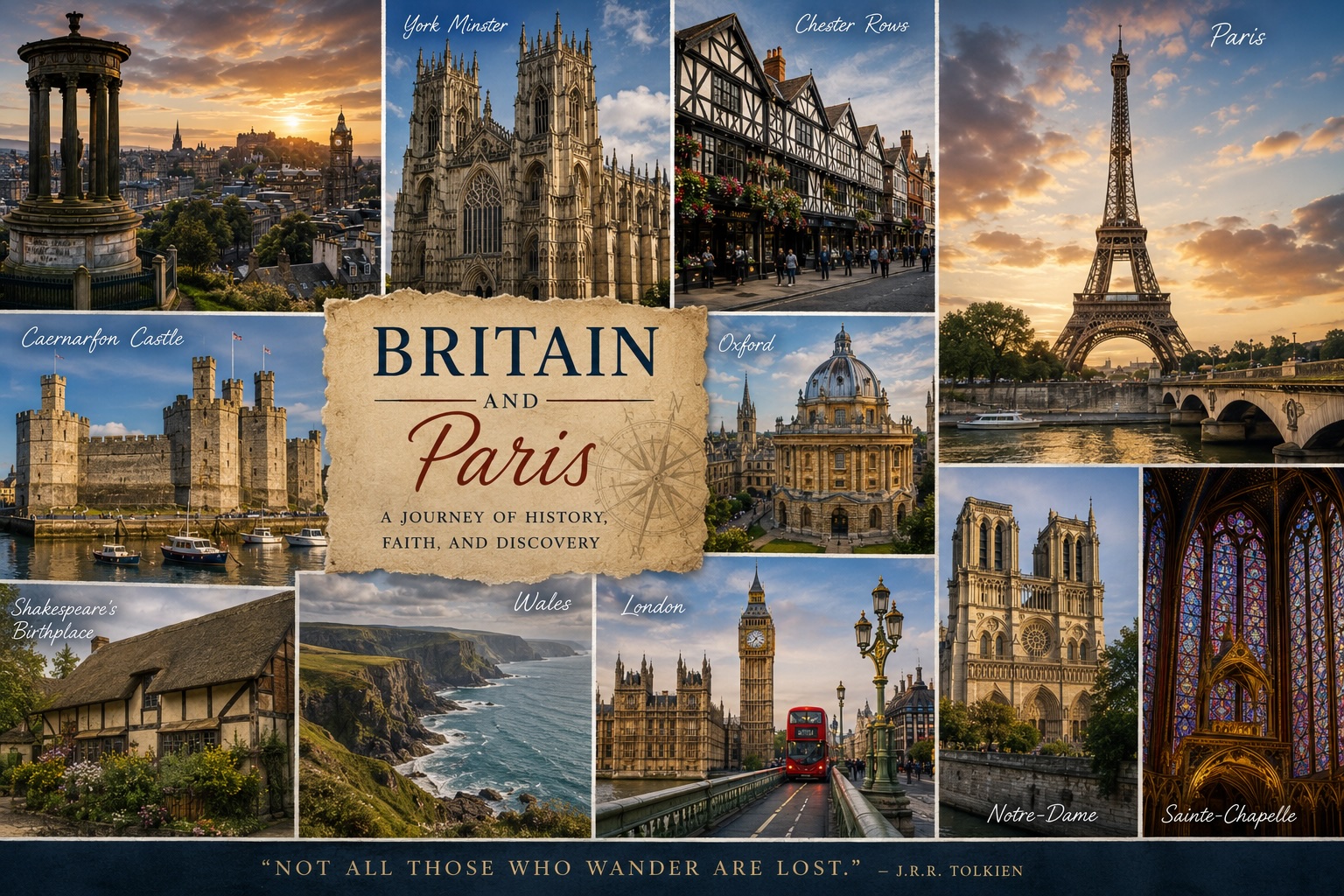
When we booked this trip, I expected castles, cathedrals, and famous landmarks. I expected history. What I didn’t expect was how much of the journey would become a reflection on faith, culture, truth, and the strange ways we attach meaning to places.
Our guide, Henryk, later wrote that he wanted us to get a feel for the culture of the United Kingdom. Mission accomplished.
We walked the medieval streets of Edinburgh, where history doesn’t feel preserved so much as lived in. We toured York Minster, a structure that took centuries to build and generations to complete. Some of us sampled local wines at Yorkshire Heart Vineyard, where I managed to get a laugh from the group by noting that if 2020 killed off a lot of vines, it wasn’t exactly a great year for the rest of us either.
We explored Chester’s Roman heritage and wandered past its famous Rows. We traveled into Wales and visited Caernarfon Castle, hearing Welsh spoken around us and realizing that identities and languages can survive centuries of conquest and change.
I found myself fascinated by systems; how nations hold together, how traditions persist, and how cultures adapt. Henryk talked about Scottish and Welsh independence movements, the flying of flags from lampposts, and the debates shaping modern Britain. Maybe that’s the software engineer in me. I don’t just see things as they are. I want to understand why they work.
Or why they don’t.
We made our way to Shakespeare country. I’ll confess that Shakespeare has never been my favorite. The same reason I struggle with the King James Bible applies here. Language evolves. I prefer clarity. Give me the NIV and Logos Bible Software where I can examine the Greek and Hebrew in context and arrive at my own conclusions.
Oxford may have been my favorite stop in England. Not because of the architecture, although it was beautiful, but because of the minds that walked those halls. John Wesley. C.S. Lewis. John Lennox. People wrestling with faith, reason, and truth. The engineer in me found kindred spirits there.
Then there were the churches.
By the time I reached Paris, I was suffering from what I jokingly called “church fatigue.” York Minster. Oxford chapels. Cathedrals. Basilicas. Notre-Dame. Sainte-Chapelle.
As someone raised Catholic who now worships in a Global Methodist church that meets in a YMCA, I found myself wrestling with questions I’d been asking for years.
What is the Church?
To me, the Church isn’t stone and stained glass. It isn’t marble floors or gold reliquaries. The Church is people. It’s the Body of Christ.
Walking through Europe’s grand cathedrals, I couldn’t ignore the tension I felt seeing extraordinary wealth invested in structures while poverty existed outside their doors. The Reformation didn’t arise in a vacuum. Questions about church authority, wealth, relics, and priorities have been debated for centuries.
I found myself skeptical of relics. The Crown of Thorns. Stories of saints carrying their severed heads. Claims that statues weep. My instinct has always been to ask questions.
Where is the evidence?
What is the chain of custody?
Is this tradition, symbolism, devotion, or historical reality?
To me, truth matters. God is truth. If something cannot be known with certainty, I struggle when certainty is claimed anyway.
I don’t doubt that many people are sincere in what they believe. I simply process these things differently. I view faith through the lenses of Scripture, evidence, and reason.
Perhaps that’s why Oxford resonated with me so deeply.
Paris surprised me.
If I’m being honest, I liked Ireland better.
Ireland captured my heart with its warmth, scenery, and people. Britain engaged my mind. Paris fascinated me in other ways.
I noticed fewer overweight people and more public smoking. I noticed grass growing on rooftops and wondered how they prevented leaks. I marveled at green roofs functioning as infrastructure. I squeezed into tiny restaurant tables clearly not designed with suburban Americans in mind.
And then there were the movies.
I realized I don’t just love action films. I love cinematography and location.
The John Wick stairs at Sacré-Cœur may have been the highlight of my Paris experience. Standing there and recognizing them instantly made me happier than another cathedral probably should have.
I thought about Mission: Impossible, Jason Bourne, James Bond, Rush Hour 3, and Darkman. I realized I love movies where cities become characters. I don’t just want to see a place. I want to connect it to a story.
I climbed part of the Eiffel Tower. Heights have never been my thing. I’ve learned enough about myself to know when pushing through discomfort becomes needless misery. I stayed where I was comfortable and walked down the stairs.
That was enough.
Travel also has a way of teaching you about yourself.
I learned that I enjoy quick wit and conversations more than tourist attractions. I prefer pubs to cathedrals. I like understanding how things work beneath the surface. I notice details other people overlook; the systems, the incentives, the inconsistencies.
I also discovered that after two weeks of hotels, airports, group schedules, and living out of a suitcase, I was ready to come home.
Very ready.
The ringing in my ears was turned up to eleven. Airports blurred together. Charles de Gaulle felt like an entire city. Atlanta was one final hurdle between me and Pittsburgh. I’d been awake since four in the morning Paris time.
I couldn’t wait to sleep in my own bed.
Travel changes you, but it also reminds you who you are.
I returned with memories of medieval streets, Welsh voices, Oxford scholars, Paris skylines, church debates, pub laughter, and conversations about truth.
I also came home with renewed appreciation for ordinary things.
My own pillow.
My own routines.
The comfort of home.
I don’t know if I’ll ever fully understand why some people are moved to tears by cathedrals that strike me as simply stone and glass.
But I understand this:
The Church is people.
Truth matters.
Stories connect us to places.
And after seeing some remarkable parts of the world, there’s still something sacred about coming home.