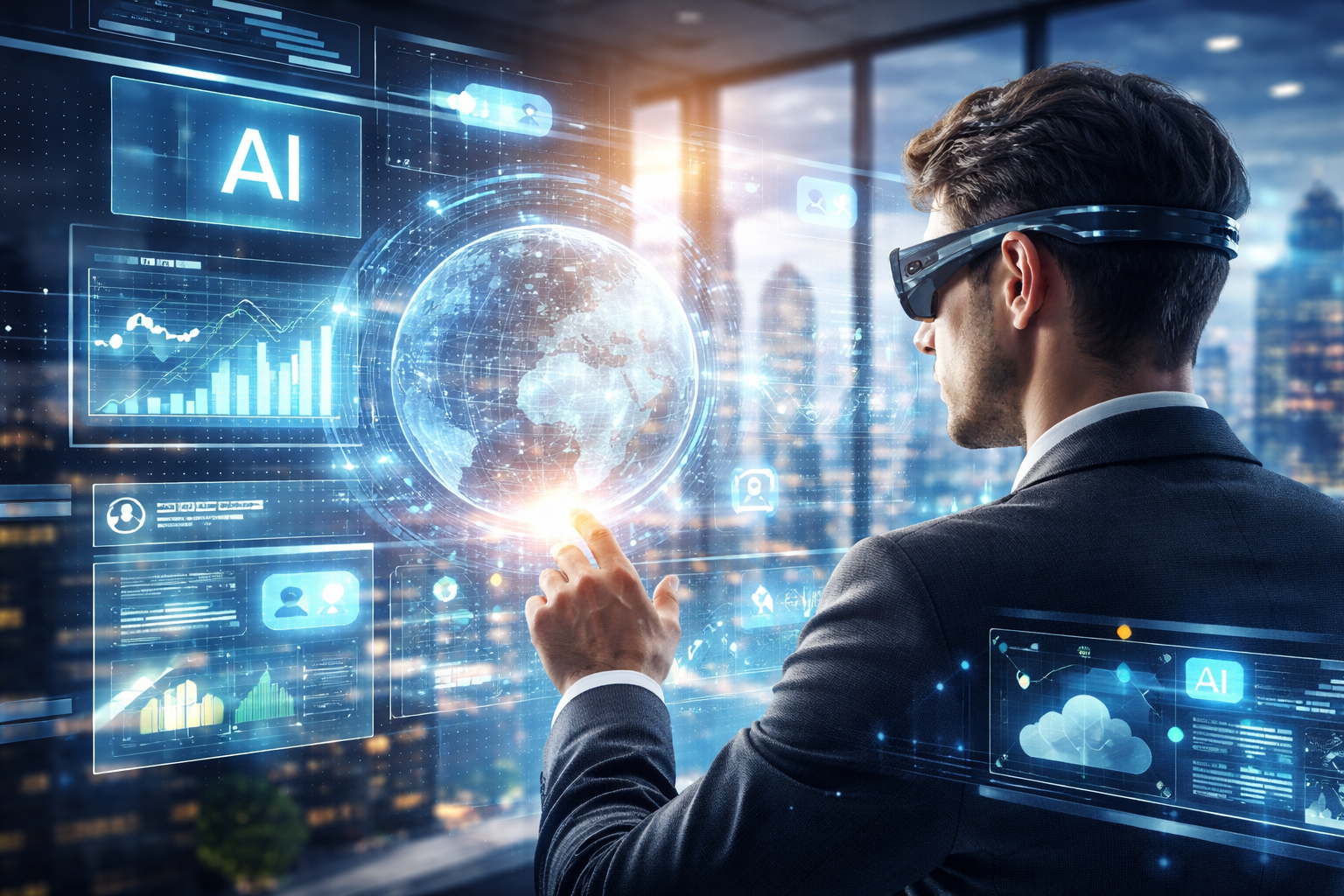
The next major technology shift isn’t about escaping reality—it’s about augmenting it.
While virtual reality once dominated headlines, momentum has clearly shifted. Artificial intelligence is now the primary catalyst for transformation, and augmented reality (AR) is emerging as the most practical interface for bringing that intelligence into everyday workflows.
Instead of fully immersive virtual worlds, we’re entering an era where AI enhances the physical world in real time.
Smart glasses and spatial computing are evolving into lightweight, AI-powered companions that provide contextual awareness, visual recognition, and instant access to information. Rather than replacing reality, AR layers intelligence directly onto it—and that distinction matters.
From Immersion to Augmentation
My current focus is on the convergence of AI and AR/MR. These aren’t buzzwords; they represent a fundamental change in how people interact with systems and data.
AI is no longer confined to dashboards or keyboards. It’s becoming ambient—embedded in tools, devices, and workflows. Algorithms now personalize experiences, interpret visual environments, and adapt dynamically to user intent.
This has immediate implications across healthcare, engineering, education, and operations. Even entertainment has offered early signals of this shift—experiences like Beat Saber hint at what’s possible when computation meets embodiment—but the real impact is emerging in productivity and decision support.
Unlike VR, which still requires deliberate isolation, AR meets people where they already are.
That’s where adoption accelerates.
How AI Is Already Embedded in Daily Work
AI now plays a central role in both my professional and personal workflows.
Tools like ChatGPT assist with writing, ideation, and refinement. Microsoft Copilot functions as a digital collaborator—supporting meeting preparation, automation, and technical tasks.
Beyond language, AI is reshaping observability, application performance monitoring, and analytics—helping teams interpret complex systems faster and make better decisions. Platforms like LinkedIn are integrating AI directly into professional workflows, while tools such as DALL·E demonstrate how generative models can translate ideas into visual artifacts.
This is what distinguishes AI from previous technology waves: it’s horizontal. It touches every discipline.
Why AR Is Becoming the Next Computing Interface
AR represents the natural extension of AI into the physical world.
Smart glasses already demonstrate how visual input can be combined with AI to provide real-time context—recognizing objects, summarizing environments, and supporting navigation or task execution. These capabilities have enormous potential in accessibility, healthcare, field operations, and remote collaboration.
Imagine technicians receiving step-by-step overlays on equipment, clinicians accessing patient context at a glance, or distributed teams collaborating spatially instead of through flat screens.
Popular culture has long imagined this future—think Free Guy or the augmented interfaces associated with Tony Stark—but today’s progress is grounded in real engineering advances like waveguide optics and edge AI, steadily improving form factors and reducing power requirements.
AR is moving toward becoming an always-available interface—not a novelty device.
VR Still Matters—But It’s No Longer the Center of Gravity
Virtual reality continues to offer value for training simulations, gaming, and specialized visualization. Devices such as Meta Quest 3 and earlier platforms like Oculus Quest 2 demonstrated real demand, particularly during the pandemic.
But VR remains a destination experience—something you step into.
AR, by contrast, is becoming ambient and continuous. It integrates into daily life and work without requiring separation from the physical world. That difference fundamentally changes adoption dynamics.
Looking Ahead
The future of human–computer interaction lies in AI-powered augmentation.
We’re moving toward environments where intelligence is embedded directly into our field of view—supporting real-time translation, spatial collaboration, contextual assistance, and AI copilots that operate alongside us.
While Artificial General Intelligence remains theoretical, narrow AI combined with AR is already delivering tangible results: faster decisions, richer collaboration, and entirely new modes of productivity.
This is not about replacing people.
It’s about amplifying human capability.
And that’s where the real transformation is happening.