Modern distributed systems don’t fail loudly — they fail subtly.
A small latency increase in one service cascades into customer impact three layers away. A misconfigured feature flag quietly degrades performance. A database connection pool exhausts itself under load.
By the time humans notice, the system is already burning.
This is exactly where Model Context Protocol (MCP) changes the game.
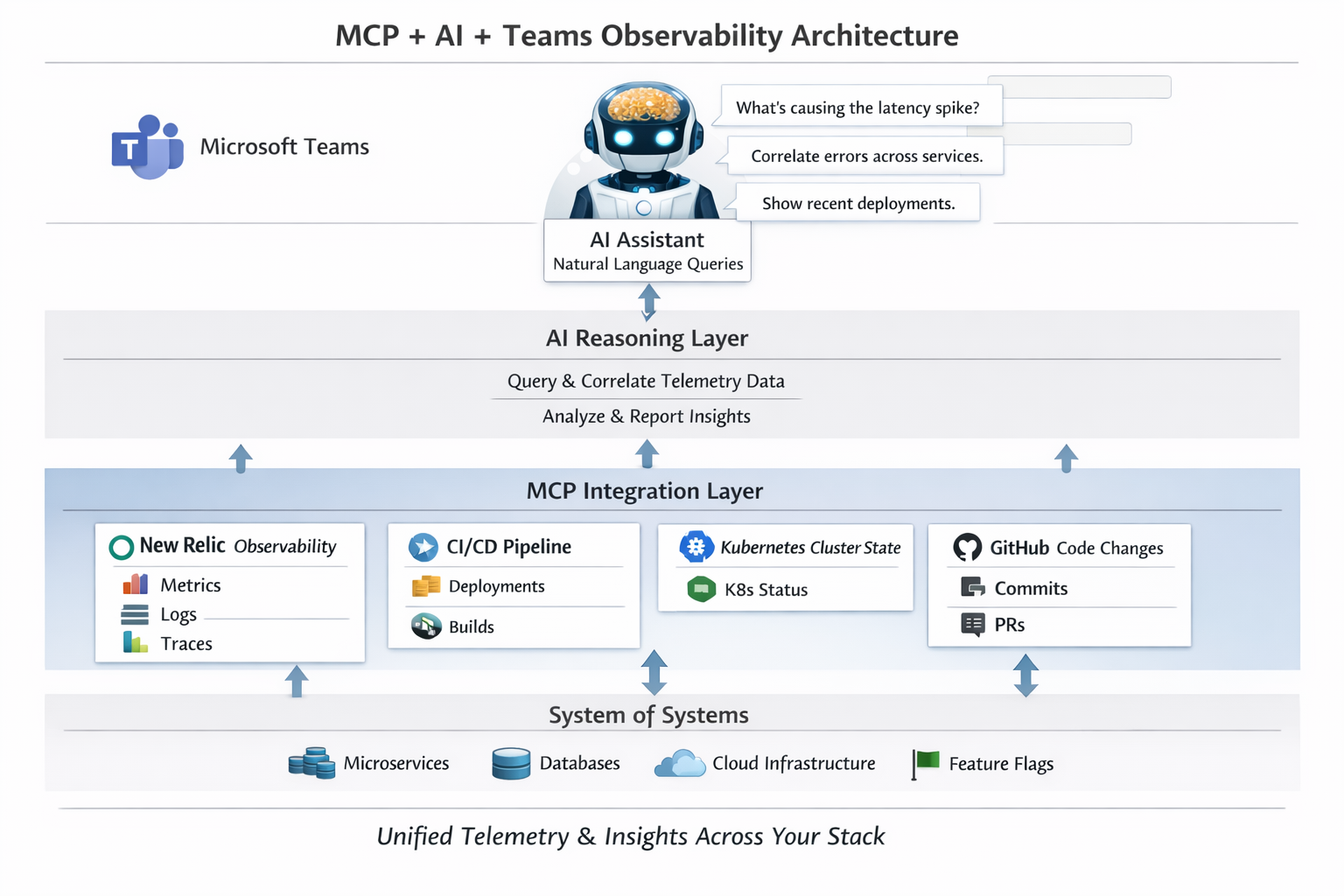
Rather than treating observability tools, collaboration platforms, and AI assistants as separate islands, MCP allows you to expose telemetry, metrics, logs, traces, and domain knowledge directly to AI — and bring that intelligence into your everyday workflows.
Imagine asking questions in Microsoft Teams like:
“Why did checkout latency spike in the last 15 minutes?”
“Show me correlated errors across services.”
“Did this deployment introduce regressions?”
…and getting real answers backed by live production telemetry.
No context switching. No dashboard spelunking.
Just answers.
MCP as the Observability Nervous System
At its core, MCP provides a standardized way for AI models to interact with external systems.
Think of it as a universal adapter:
- Metrics platforms
- Logging systems
- Tracing backends
- Incident tools
- CMDBs
- Deployment pipelines
- Feature flag services
Each becomes an MCP server exposing structured capabilities.
Your AI assistant becomes the client.
Instead of static prompts, the model gains situational awareness of your production environment.
Using New Relic MCP for Telemetry Inside Teams
Platforms like New Relic are already moving aggressively into this space with AI-powered observability.
With an MCP integration layered on top, New Relic effectively becomes a real-time data source for your AI assistant.
Now your Teams conversations can directly query:
- Golden signals (latency, traffic, errors, saturation)
- Distributed traces
- Deployment markers
- Infrastructure health
- Application error rates
Instead of opening dashboards, engineers can simply ask:
“Correlate frontend errors with backend latency since the last deploy.”
Behind the scenes:
- The AI calls the New Relic MCP server
- Queries metrics and traces
- Performs correlation analysis
- Returns summarized findings directly in Teams
This collapses minutes (or hours) of manual investigation into seconds.
Going Beyond One Tool: Multi-MCP System Intelligence
Here’s where things get truly powerful.
You don’t stop at observability.
You expand MCP across your ecosystem:
Example MCP Providers
- New Relic — telemetry and tracing
- GitHub — code changes and PRs
- Kubernetes — cluster state
- Feature flag platforms — runtime configuration
- CI/CD — deployment history
- ServiceNow — incidents and changes
- Cloud providers — infrastructure health
Each MCP exposes a narrow slice of truth.
Together, they form a distributed intelligence fabric.
Now when something breaks, AI can reason across all layers:
- What changed?
- What degraded?
- Where did errors originate?
- Which customers were impacted?
- Is this correlated with infrastructure or application behavior?
This is no longer observability.
This is system reasoning.
From Dashboards to Conversations
Traditional observability assumes humans will:
- Notice something is wrong
- Open multiple tools
- Correlate signals manually
- Form hypotheses
- Validate assumptions
That model doesn’t scale.
With MCP + AI, the workflow flips:
- Engineers ask natural language questions
- AI gathers telemetry across systems
- AI proposes root causes
- Humans validate and act
Teams becomes your war room.
AI becomes your first responder.
Why This Matters for Platform Enablement
From my own experience leading DevOps and DataOps enablement across regulated enterprise environments, the biggest bottleneck has never been tooling.
It’s cognitive load.
Engineers lose time jumping between dashboards, logs, tickets, pipelines, and Slack threads while incidents unfold.
MCP removes that friction.
It centralizes context.
It enables:
- Faster MTTR
- Better root cause analysis
- Reduced alert fatigue
- More confident deployments
- Higher engineering throughput
This aligns directly with modern platform engineering goals:
- Self-service diagnostics
- Embedded SRE practices
- AI-assisted operations
- Continuous feedback loops
When you combine MCP with AI, observability becomes proactive instead of reactive.

A Caution on AI-Driven Operations
One important warning.
AI is only as good as:
- The telemetry you expose
- The business context you provide
- The guardrails you define
AI may understand patterns.
It does not inherently understand business rules.
Just like AI-generated code, AI-generated operational insights must be reviewed by humans who understand:
- Customer impact
- Regulatory constraints
- Domain logic
MCP doesn’t replace engineers.
It amplifies them.
The Future: AI as Your Systems Co-Pilot
We’re entering a world where:
- AI monitors production continuously
- MCP connects every critical system
- Teams becomes the command center
- Engineers collaborate with AI in real time
This is not speculative.
It’s already starting.
The organizations that win won’t be those with the most dashboards.
They’ll be the ones who turn telemetry into intelligence — and intelligence into action.
MCP is the bridge.