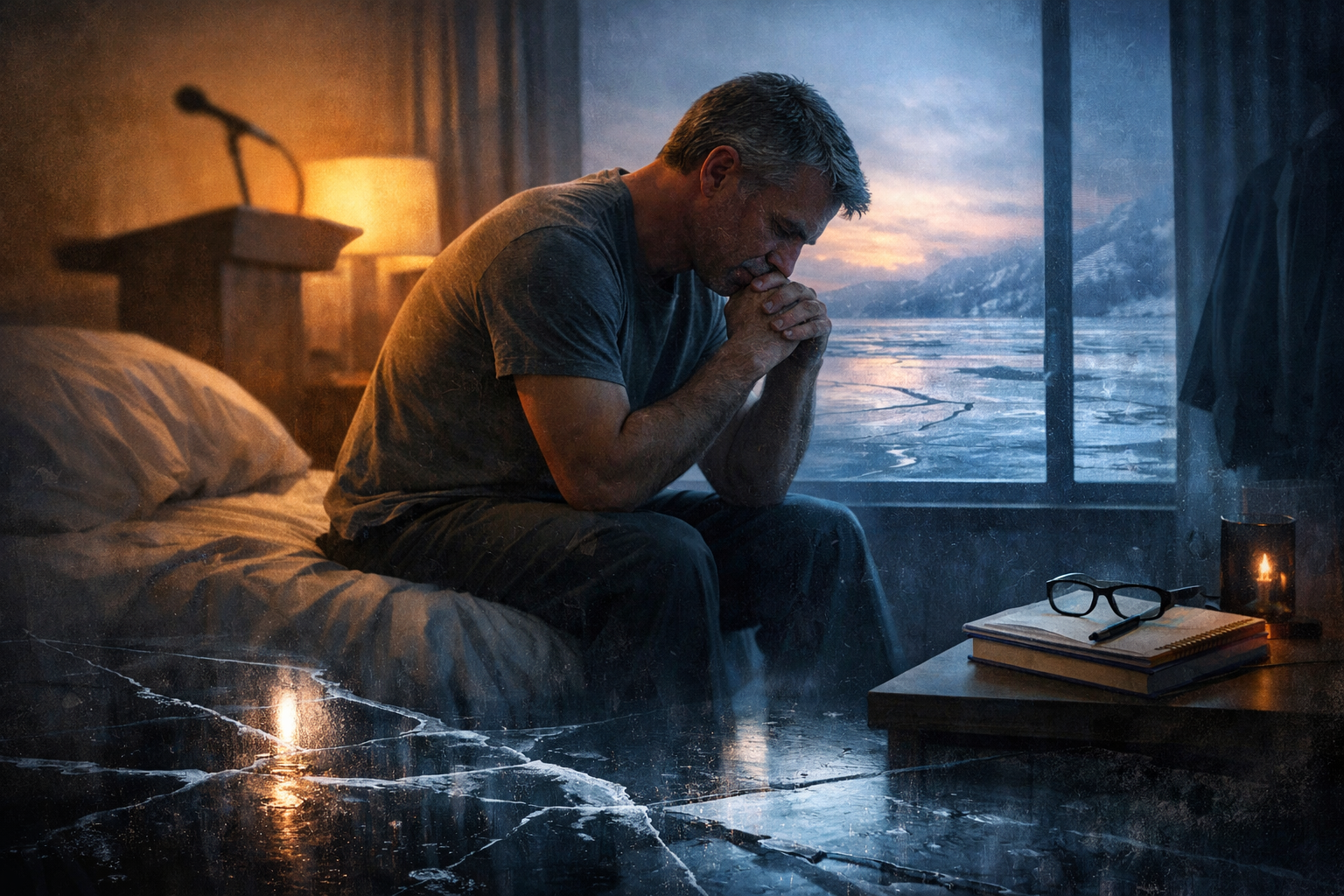
A reflection on the two years that stripped away almost everything I thought defined me — and what I found underneath.
I have spent most of my adult life knowing exactly who I was. I was a professional. A speaker. An author. A man in the full, uncomplicated sense of the word — or so I believed. My career was not just what I did; it was the architecture of my identity. And my body? That was simply the vehicle that carried me from one stage to the next. I did not think much about either of them. You rarely do, until they are taken from you.
The past two years have been an education in loss that I did not sign up for. First came the prostate cancer diagnosis, and with it the decision to have a prostatectomy. The surgery did what it was supposed to do. It also did things I was not fully prepared for — incontinence, erectile dysfunction, the suppression of testosterone that quietly dims something in you before you even realize the light has changed. I was alive. I was grateful. I was also, in ways I am still learning to name, someone I did not entirely recognize.
“What does it mean to be a man when the body that housed your masculinity no longer behaves the way it always has?”
That question is not rhetorical. I sat with it for a long time before I could even say it out loud. Our culture gives men almost no language for this. We are handed strength and stoicism as the two acceptable tools in the toolbox, and neither one is much help when you are standing in the bathroom at 3 a.m. wondering who you are now. I had built an identity that I thought was solid — and the surgery cracked the foundation.
Then, just as I was beginning to find my footing again, I lost my job. For someone whose professional life had been woven from decades of speaking, writing, and building a career brick by careful brick, this was not simply an inconvenience. It felt like an amputation. The work was not just the income. It was the proof. Proof that I had something to offer. Proof that I mattered. Without it, I found myself in a strange, disorienting quiet, asking the same question the surgery had first posed: who am I, really, without the things I thought defined me?
Writing Thin Ice was, in part, an attempt to answer that question — or at least to be honest about asking it. The thin ice in the title is not just a metaphor for external risk. It is the feeling of stepping out onto a surface you trusted completely and hearing it groan beneath your feet. It is the moment you realize that the solid ground of your identity was always, in some sense, an assumption.
“Losing the things that defined me forced me to ask what was actually there before the definitions arrived.”
Here is what I have learned, imperfectly and still in progress: identity built entirely on roles — professional, physical, social — is identity built on sand. Not because those things are unimportant. They are. But because they can be taken. Cancer doesn’t ask permission. A layoff doesn’t wait for a convenient time. When those external pillars fall, you need something underneath them that doesn’t fall with them.
I do not have a tidy resolution to offer you. I am still in the middle of this. What I do have is the conviction that the question itself is worth asking — and that the asking, as uncomfortable as it is, is where something more durable begins to grow. If you’ve been through something that shook who you thought you were, I suspect you know exactly what I mean.
Leave a Reply