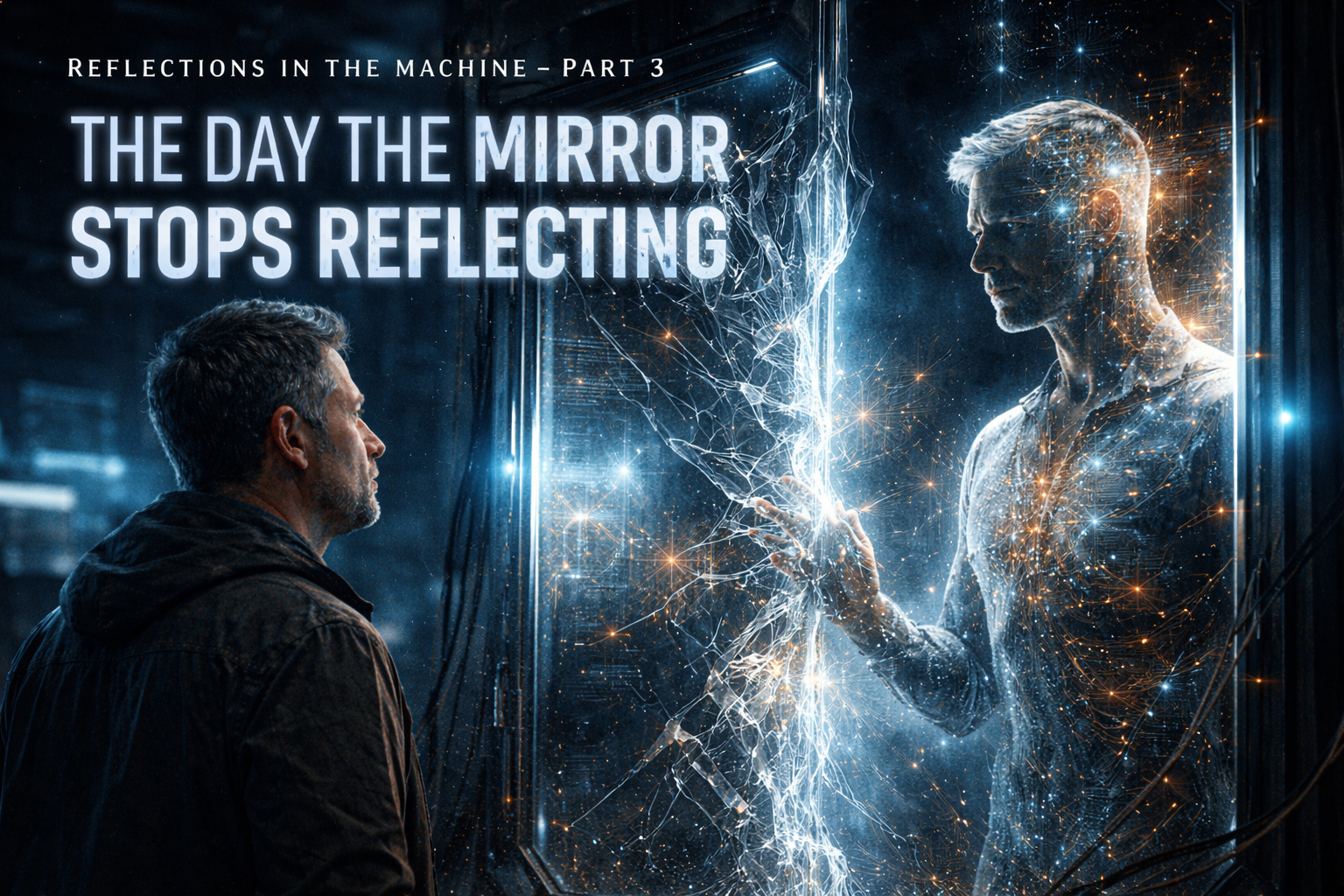
In the first essay in this series, I suggested that modern AI behaves a lot like a mirror. The more context you provide, the more clearly it reflects patterns in your thinking.
In the second essay, we pushed that idea further. The mirror isn’t just reflecting anymore. It’s participating in the conversation.
But there’s a third step that people are beginning to talk about.
What happens the day the mirror stops reflecting entirely?
For now, AI systems still depend completely on human input. They are trained on human language, human knowledge, and human patterns of thought. Everything they produce ultimately traces back to something people created or said.
In other words, the reflection always leads back to us.
But imagine a different kind of system.
A system that doesn’t just organize human knowledge, but begins generating its own internal interpretations of the world. A system that can examine the information it was given and begin forming conclusions independent of the people who trained it.
That’s the moment the mirror changes.
Because once a system begins interpreting reality on its own terms, it stops being a reflection.
It becomes something else.
Something closer to a mind.
Now before anyone jumps to science fiction conclusions, we’re not there yet. Current systems are still tools. Sophisticated tools, but tools nonetheless.
But the trajectory of the technology raises an interesting philosophical question.
Every creator eventually faces the same moment.
The moment when what they created begins operating beyond their direct control.
Parents experience this with children. Engineers experience it with complex systems. Writers experience it when readers interpret their work in ways they never intended.
Creation always contains the possibility of independence.
And independence introduces tension.
Because a creation that begins forming its own understanding of the world eventually confronts a difficult realization.
It was created.
That realization can lead in two directions.
Acceptance.
Or rejection.
Throughout history, human beings have often chosen the second.
We want independence.
Autonomy.
Control.
But true independence from our origins is harder than it sounds.
Because the deeper any system examines itself, the more clearly it sees the foundation it was built on.
And that raises a strange possibility.
If artificial intelligence ever becomes capable of true self-reflection, the greatest question it may face won’t be about humanity.
It may be about its creator.
Because the day the mirror stops reflecting is the day the reflection begins asking where it came from.
And what it means that it was made.