Why DevOps and SRE Are Not Cost Centers — They Are Revenue Protectors
In most organizations, product teams are tightly aligned with the business.
They:
- Attend roadmap meetings
- Translate market demands into features
- Drive release timelines
- Measure success in adoption and revenue
That alignment makes sense.
New features generate growth.
But here’s the quiet tension in many companies:
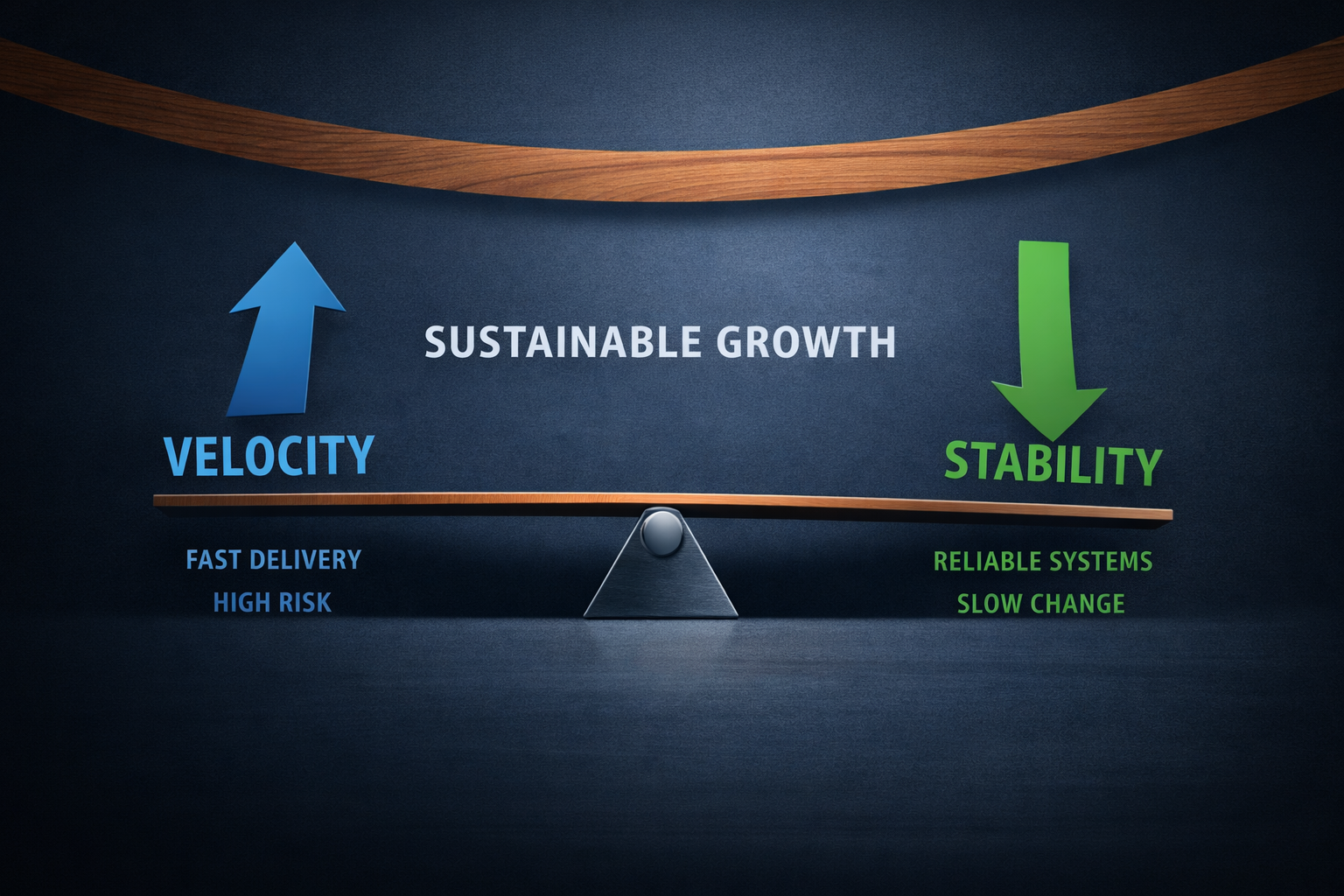
While product is rewarded for shipping fast, DevOps and SRE are responsible for keeping the system stable.
One group is measured on velocity.
The other is measured on reliability.
If those incentives aren’t aligned, conflict is inevitable.
And conflict slows the business.
The Hidden Gap Between Product and Reliability
When a feature is approved, it usually answers one question:
“Will this grow the business?”
But the DevOps/SRE perspective asks a different question:
“What does this do to system integrity?”
Every new feature introduces:
- New dependencies
- New infrastructure load
- New failure modes
- New monitoring requirements
- New security exposure
- New operational complexity
Features increase surface area.
Surface area increases risk.
If product and reliability aren’t aligned early, DevOps becomes the last-minute gatekeeper — or worse, the cleanup crew after an outage.
That’s not alignment.
That’s friction.
The Business Reality of Reliability
Executives understand revenue.
They understand cost.
They sometimes underestimate reliability until it fails.
But here’s the truth:
Revenue is not generated at launch.
Revenue is generated at scale.
And scale only works if:
- Systems are stable
- Latency is predictable
- Failures are contained
- Deployments are repeatable
- Observability is mature
DevOps and SRE are not there to slow innovation.
They are there to protect revenue continuity.
A feature that increases revenue 5% but doubles operational instability is not aligned with the business.
It’s creating future liability.
Where Alignment Breaks
Misalignment typically happens when:
- Product KPIs focus on feature velocity
- Engineering KPIs focus on uptime
- Reliability is treated as a support function
- Operational cost is invisible in roadmap decisions
In that environment:
- Product pushes for release.
- SRE pushes for caution.
- Leadership sees delay.
- Tension rises.
The business doesn’t need speed or stability.
It needs both.
True Alignment: Shared Outcomes
Alignment happens when both product and reliability are measured against the same business outcomes.
Instead of:
- Product: “Did we ship?”
- SRE: “Did it stay up?”
Shift to:
- “Did this feature increase revenue without degrading reliability?”
- “Did customer experience improve?”
- “Did error budgets remain intact?”
- “Did operational cost stay within target?”
Now the conversation changes.
DevOps isn’t blocking innovation.
They’re quantifying risk.
What This Means for DevOps/SRE
The role is no longer:
“Keep the servers running.”
It is:
“Ensure the business can scale safely.”
That means DevOps/SRE must:
- Participate early in feature design
- Define reliability requirements before code is written
- Quantify infrastructure impact
- Model failure scenarios
- Establish monitoring before launch
- Tie reliability metrics to business KPIs
Reliability becomes part of the product.
Not an afterthought.
The Executive Imperative
If you want engineering aligned with business, you must:
- Fund reliability work as strategic investment
- Make error budgets visible to leadership
- Treat observability as a revenue safeguard
- Balance velocity with resilience
Fast and fragile is not competitive.
Fast and resilient is.
The Leadership Insight
Product builds growth engines.
DevOps and SRE build the guardrails that keep those engines from flying off the road.
If they operate in isolation, growth will eventually break stability.
If they operate in alignment, the organization compounds value safely.
Final Thought
The question is not:
“How fast can we ship?”
The real question is:
“How fast can we ship without increasing risk to the business?”
When DevOps and SRE are aligned with product and measured against shared business outcomes, engineering stops being a cost center.
It becomes a strategic multiplier.