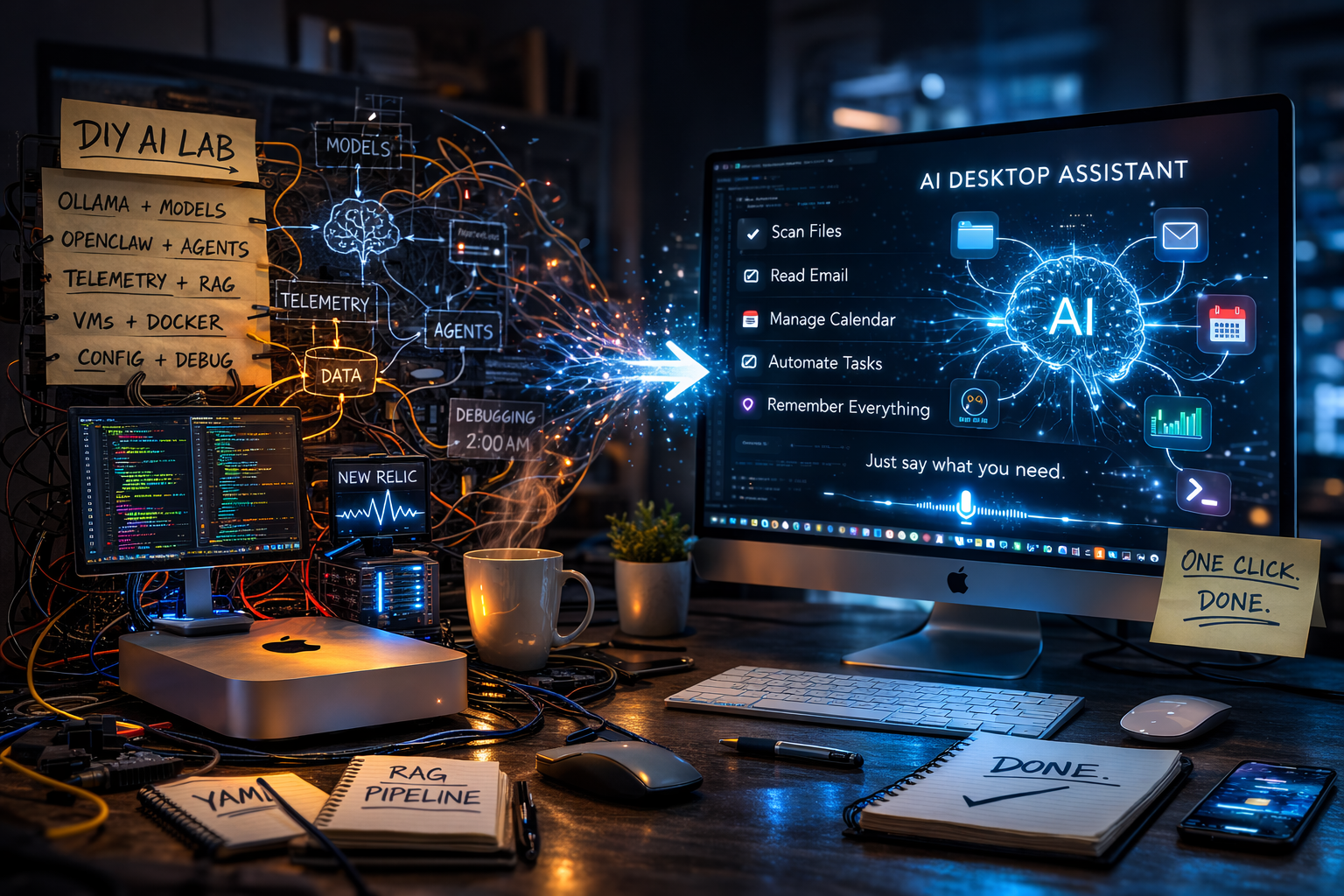
When I built my Mac Mini AI lab, it felt like 1995 again.
Local models.
Ollama.
VMs in Parallels.
OpenClaw agents.
Telegram bots.
New Relic instrumentation feeding telemetry into reasoning loops.
It was fun.
It was technical.
It scratched that engineer itch that says:
“I want to understand what’s happening under the hood.”
And I still think building your own AI lab is valuable.
But here’s the uncomfortable truth:
Most of what we’re building manually today will ship out-of-the-box tomorrow.
The Abstraction Wave Is Already Here
Claude can now scan your desktop and organize screenshots.
AI clients can:
- Read your email
- Manage your calendar
- Inspect local documents
- Execute commands
- Persist memory
- Integrate into your OS
Soon, every mainstream AI client will:
- Index your filesystem
- Act as a local agent
- Coordinate workflows
- Connect to SaaS apps natively
- Run background automations
No Docker.
No VMs.
No hand-rolled RAG pipelines.
Just:
“Allow access to Documents?”
Click.
Done.
So Why Build a Lab At All?
Because abstraction always hides complexity — it never eliminates it.
When WordPress launched, people said:
“Web developers are done.”
Instead, we got:
- Hosting engineers
- Performance optimization
- Plugin ecosystems
- Security consultants
- Platform architects
Same thing here.
Consumer AI clients will abstract 80% of the use cases.
But they won’t eliminate:
- Architecture decisions
- Governance concerns
- Observability
- Cost control
- Data security
- Enterprise integration
- Model orchestration
- Telemetry-aware reasoning
Those layers move down the stack.
They don’t disappear.
My Mac Mini Lab Was Never About the Hardware
It wasn’t about running Llama locally.
It wasn’t about OpenClaw.
It wasn’t about wiring New Relic into an LLM.
It was about understanding:
- Where AI meets infrastructure
- Where agents meet telemetry
- Where automation meets control
- Where convenience meets risk
Because once AI clients become OS-native, the real questions shift to:
- Who controls the data?
- Where is memory stored?
- What happens when AI agents execute actions autonomously?
- How do you observe and govern them?
- How do you cost-manage reasoning at scale?
That’s not consumer territory.
That’s enterprise territory.
The Nerd Phase Is Temporary
Right now we’re in the “Home Lab Phase” of AI.
It looks like:
- Self-hosted models
- Custom agents
- Manual integrations
- YAML files everywhere
- Late nights debugging config issues
But just like cloud, containers, and DevOps:
What’s DIY today becomes platformized tomorrow.
And that’s okay.
Because once platforms stabilize, a new layer of complexity appears.
And that’s where experienced engineers step in.
The Real Shift
AI is becoming an operating system layer.
When that happens:
- Individuals will use the default AI client.
- Enterprises will need architecture.
And architecture is where leverage lives.
So Should You Build a Lab?
Yes.
But not because you’re trying to outbuild Claude.
Build it because:
- You want to understand what’s under the abstraction.
- You want to see the data flow.
- You want to experiment without guardrails.
- You want to understand the cost and risk model.
- You want to anticipate the next layer.
But don’t confuse tinkering with long-term differentiation.
The differentiation is not in spinning up Ollama.
It’s in understanding what happens after AI becomes invisible infrastructure.
The Pattern Is Familiar
I’ve watched this happen before:
Hand-coded HTML → WordPress
On-prem servers → AWS
Manual deploys → CI/CD
VMs → Kubernetes
Kubernetes → Platform Engineering
And now:
DIY AI labs → OS-native AI agents
The cycle is the same.
Abstraction rises.
Control shifts.
A new layer emerges.
Final Thought
My Mac Mini lab won’t be obsolete because Claude can organize my screenshots.
It will be obsolete because AI will soon be ambient.
Always present.
Always connected.
Always watching context.
The real question isn’t:
“How do I build my own AI assistant?”
It’s:
“What does architecture look like when AI becomes the operating system?”
That’s the layer worth paying attention to.