Why IDPs aren’t portals — they’re standardized access to reality.
Over the last few articles, I’ve been exploring how AI, observability, and SRE are converging into something bigger than any single tool: a closed-loop engineering system where intent, execution, and experience are continuously connected.
That naturally leads to Internal Developer Platforms (IDPs).
But here’s the thing.
When you strip away the marketing, dashboards, and templates, an IDP really boils down to something much simpler:
An IDP is one standard way of accessing a lot of underlying structure.
That’s it.
Everything else — portals, golden paths, scaffolding, AI assistants — are just implementations of that idea.
The Real Role of an IDP
Modern engineering environments are built on layers of complexity:
- CI/CD pipelines
- cloud infrastructure
- security controls
- observability platforms
- compliance policies
- ownership models
- internal documentation
Without an IDP, developers touch all of these directly, each with its own interfaces, APIs, and tribal knowledge.
With an IDP, they interact with one surface area.
Whether that surface is:
- a portal
- a CLI
- GitOps workflows
- chat interfaces
- natural language prompts
- autonomous agents
…the purpose stays the same:
Normalize access to complexity.
Or said another way:
IDPs translate human intent into system behavior.
This is why I don’t think of IDPs as “self-service platforms.”
I think of them as control planes.
The Danger: Custom Platforms and Institutional Knowledge
Once you accept that IDPs are abstraction layers, a risk becomes obvious:
If every organization invents its own platform semantics, workflows, and concepts, you don’t reduce institutional knowledge.
You entrench it.
You end up with:
- bespoke abstractions
- unique pipelines per company
- undocumented assumptions
- senior engineers as living documentation
The complexity doesn’t disappear.
It just moves behind a prettier interface.
In other words:
You didn’t reduce complexity — you relocated it.
This is where many early IDP efforts stalled. Companies built portals, but not shared mental models.
Why Standardization Matters More Than Tooling
The real value of an IDP isn’t convenience.
It’s the opinionated contract between:
- developers
- platform teams
- security
- operations
- leadership
That contract defines:
- how services are created
- how ownership is expressed
- how environments work
- how policies are enforced
- how observability is wired
- how incidents flow
Without that shared contract, AI just accelerates chaos.
This is why platforms like Backstage (now under the Cloud Native Computing Foundation umbrella) mattered — not because they were great portals, but because they introduced common primitives:
- service catalogs
- ownership metadata
- templates
- tech docs
- plugin models
They gave organizations a starting grammar for platform design.
Same pattern as Kubernetes.
Everyone deploys it differently.
But we all agree what a Pod is.
Enter AI: From Self-Service to Self-Driving
With AI embedded into engineering workflows, IDPs are evolving fast.
Instead of manually selecting templates, developers can now express intent:
“Create a production-ready Go service with Postgres.”
The platform:
- scaffolds code
- provisions infrastructure
- applies security guardrails
- wires in observability
- registers ownership
No tickets. No wiki archaeology. No tribal knowledge hunts.
This is the shift from self-service to self-driving platforms.
Agentic Platforms and Autonomous Operations
Modern IDPs are also moving toward agent-based systems.
These agents don’t just generate snippets.
They can:
- diagnose flaky tests
- suggest fixes for failed deployments
- right-size cloud resources using live telemetry
- recommend SLO adjustments based on user experience
Instead of humans constantly pulling dashboards, agents continuously evaluate signals and act.
The platform becomes operationally aware.
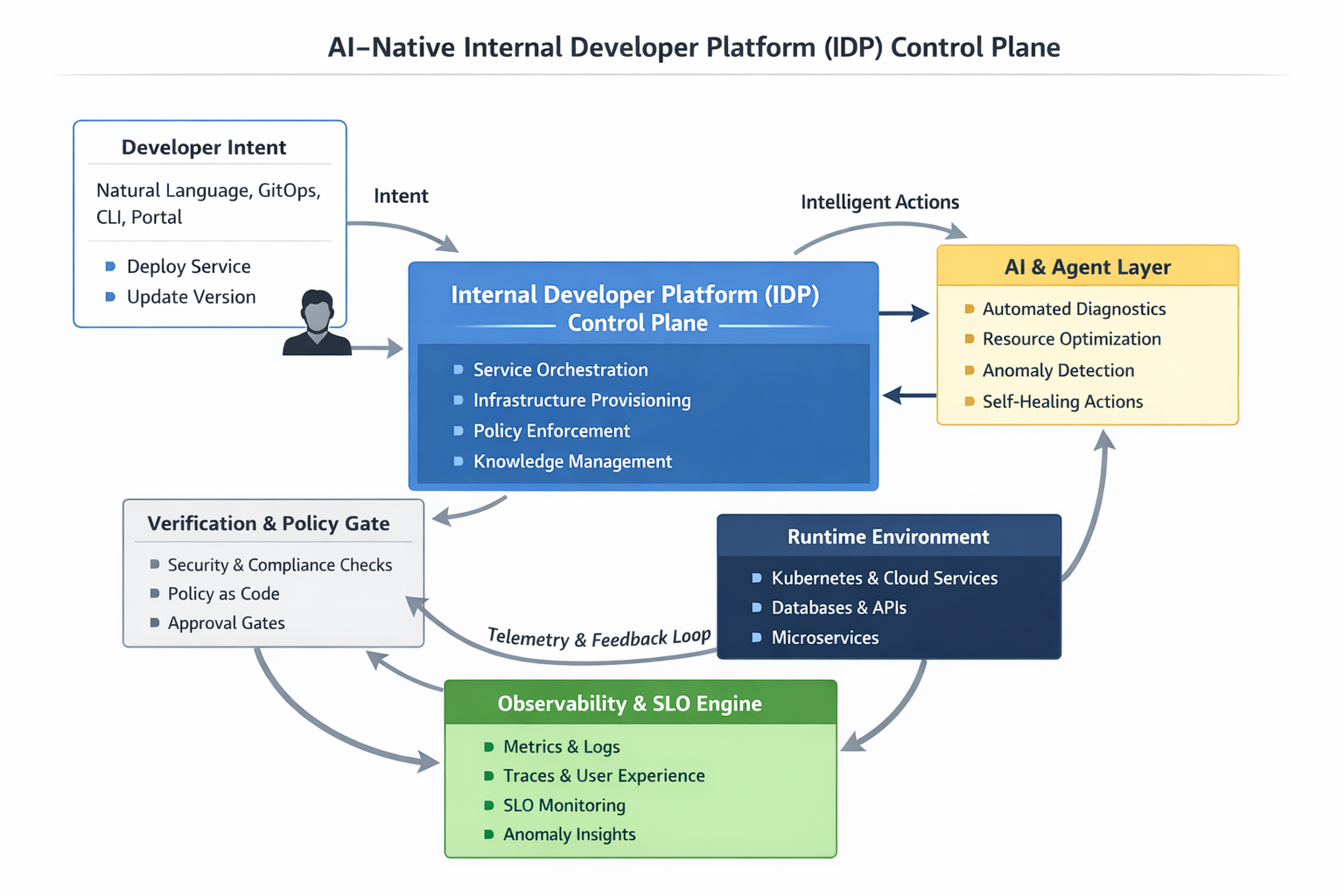
This ties directly into the MCP + SRE concepts I’ve been writing about:
- telemetry feeds reality back into the system
- AI evaluates outcomes
- the platform adjusts automatically
That’s a closed loop.
The Verification Loop: Governance Becomes the Product
AI can generate code faster than humans can review it.
So IDPs are pivoting hard toward automated verification:
- Policy-as-Code
- security scanning
- compliance checks
- architectural guardrails
Before anything reaches production.
This matters even more under frameworks like the EU AI Act, but the broader point is trust:
Speed without governance is just chaos.
In this model, the IDP becomes the gatekeeper — enforcing organizational standards regardless of whether code was written by humans or models.
Knowledge-Driven Engineering
Another major shift is making institutional knowledge queryable.
Platforms like Red Hat Developer Hub are beginning to let developers ask contextual questions such as:
- “Why do we deploy this service this way?”
- “What security exceptions exist for this repo?”
- “What happened the last time this pipeline failed?”
Instead of searching Confluence, engineers query the platform.
Internal documentation starts to talk back.
This is critical.
Because platforms shouldn’t just automate workflows — they should surface organizational memory.
Emerging Tooling Patterns
We’re also seeing AI land directly inside developer portals.
Platforms like Port and Backstage are adding assistants to help navigate complex microservice ecosystems — not just where things live, but why they exist and how they behave.
On the infrastructure side, we’re moving past reactive alerts toward predictive healing:
- subtle telemetry drift is detected
- failures are anticipated
- remediation happens automatically
- humans are alerted only when confidence drops
SLOs become living signals, not static dashboards.
And that’s where observability, SRE, AI, and IDPs finally converge.
The Bigger Picture
So what is an AI-native IDP really becoming?
Not a portal.
Not a product.
Not a DevOps tool.
It’s becoming the control plane between humans and reality.
Developers express intent.
Platforms orchestrate execution.
Observability reports experience.
AI evaluates outcomes.
The system adjusts.
Over and over.
That’s not just platform engineering.
That’s cybernetic engineering.
Final Thought
If every company builds its own Internal Developer Platform without shared conventions, we don’t reduce institutional knowledge — we entrench it.
The real power of an IDP isn’t automation.
It’s standardization.
It’s creating a common language between humans, systems — and now AI.
And in a world where software increasingly runs itself, that common language may be the most important engineering decision we make.